 Foodofile
The 'Landing Strip' Protocol: Managing the Dirty Dish Deluge Before It Starts
There is a specific moment in every high-stakes culinary performance—somewhere between searing the scallops and plating the risotto—when the kitchen turns against you. It is not a rebellion of appliances or ingredients, but of space. One minute, you are orchestrating a symphony; the next, you are boxed in by a fortress of tasting spoons, sauce-slicked sauté pans, and mixing bowls crusted with ganache.
This visual noise is not merely an aesthetic failure; it is a functional blockade. In professional kitchens, the "pass" must remain clear for service, and the "pit" (dishwashing station) is a distinct ecosystem. In a home kitchen, however, these lines blur. The sink becomes a graveyard, and the countertops become a chaotic storage unit.
The solution is not to wash every single spoon the moment it touches a counter—that disrupts the flow state of cooking. The solution is the "Landing Strip" Protocol. This is a strategic method of zoning your workspace to contain entropy, allowing you to cook with the mental clarity of a Michelin-starred expeditor, even if you are just making Tuesday night tacos.
The Philosophy of Zoning
Most home cooks operate under a linear mindset: Prep, Cook, Eat, Clean. This is a fallacy. In an efficient kitchen, cleaning is not a post-script; it is a parallel track. However, the advice to "clean as you go" is often misinterpreted as "stop cooking to wash dishes." This is inefficient. Stopping to scrub a pot interrupts the Maillard reaction you are monitoring or the emulsion you are whisking.
Instead of stopping, we divert. You need a designated buffer zone—a physical space where dirty items "land" before they are processed. This is the Landing Strip. It separates the active cooking zone from the waste stream, ensuring your cutting board remains sacred ground, untouched by the cross-contamination of used wares.
Establishing Your Landing Strip
To execute this protocol, you must sacrifice a specific section of countertop. Ideally, this is an 18-to-24-inch section immediately adjacent to your sink (and preferably above the dishwasher). If your kitchen island is your command center, the Landing Strip is the far left or right corner, strictly demarcated.
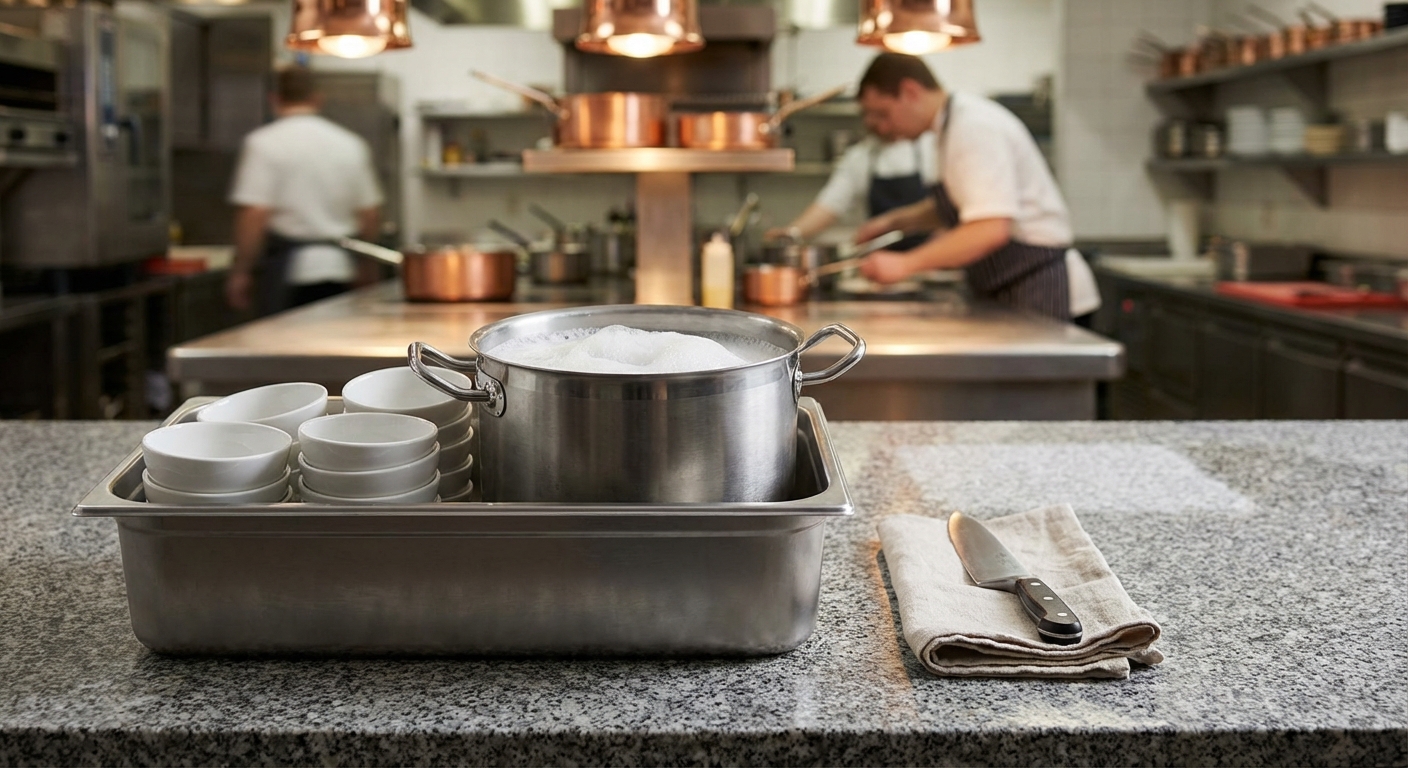
This zone requires physical boundaries. In professional kitchens, chefs use gray "bus tubs" to corral chaos. You will adopt a refined version of this. Place a rimmed baking sheet, a large roasting pan, or a dedicated architectural tray in this zone. This is the boundary. If a dirty spoon is not in the tray, it is in the wrong place.
The Three-Phase Protocol
Once your Landing Strip is defined, you must adhere to a strict behavior pattern. Do not simply toss items into the sink. A sink full of unorganized, sharp, greasy tools is a hazard that slows down eventual cleanup.
Phase 1: The Scrape and Stack
Before a plate or bowl enters the Landing Strip, it must be cleared of debris. Scrape solids into the compost or trash immediately. Then, stack the item. Do not create a leaning tower of Pisa; create stable columns. Plates with plates. Bowls with bowls. This reduces the footprint of the mess by 60%, visually tricking the brain into perceiving less clutter.
Phase 2: The Soak Strategy (ABS)
In the industry, there is an acronym: ABS (Always Be Soaking). Proteins and starches cure like cement if left to dry. On your Landing Strip, designate a "soak vessel"—perhaps your largest mixing bowl or a stockpot. Fill it with hot water and a drop of detergent. Small tools like whisks, spatulas, and tasting spoons go immediately into this bath. When it is time to wash, the debris will slide off without scrubbing.
Phase 3: The Sharps Separation
Never, under any circumstances, place a knife in a soak bucket or a sink full of suds. This is how fingers are lost. Your Landing Strip must have a "dry dock" for sharps—a small, designated spot (perhaps a folded towel) where dirty knives sit visibly until they can be safely hand-washed.
Workflow Integration
The success of the Landing Strip relies on your movement. It requires a pivot. When you finish chopping onions, you do not drop the knife on the board. You pivot to the Landing Strip, place the knife on the dry dock, and move the prep bowl to the stack. You then wipe your board. The board is now reset.
By treating the dirty dish transfer as a specific, mindful movement, you prevent the insidious creep of mess back into your prep zone. You are effectively bussing your own table while cooking, keeping your mental RAM free to focus on thermal precision and seasoning.
Save vs. Splurge: The Gear
You do not need a renovation to implement this, but the right tools elevate the experience from a chore to a system.
Save: The Commercial Bus Tub
Go to a local restaurant supply store and purchase a standard polyethylene bus box (often under $15). It isn't pretty, but it is indestructible. During a holiday feast, place this on the counter. When it fills up, you can lift the entire box and move it to a utility area or simply work through it systematically. It contains the mess completely.
Splurge: The Workstation Sink
If you are remodeling, invest in a workstation sink (like those from The Galley or Kohler). These sinks have built-in ledges that allow you to slide a drying rack or a colander over the basin. This effectively turns the air above your sink into your Landing Strip, hiding the mess below deck while keeping your counters pristine. It is the ultimate luxury in kitchen workflow—the ability to make the mess disappear instantly.
The Reset
The Landing Strip is a holding pattern, not a permanent residence. Every 45 minutes, or during a passive cooking phase (like when the roast is resting), execute a "Reset." because your items are soaking and stacked, this process is rapid. Load the dishwasher, wash the sharps, and clear the strip.
By managing the deluge before it starts, you change the narrative of cooking. You are no longer a victim of your own creativity, buried under a mountain of steel and ceramic. You are a commander, standing in a kitchen that looks as controlled at the end of the meal as it did at the start.
Sources and Further Reading
https://semistories.semihandmade.com/a-foolproof-way-to-wash-dishes/
https://www.livingetc.com/advice/things-designers-always-add-into-eat-in-kitchens
https://www.mywomenstuff.com/2019/01/landing-strip-for-home/
https://www.artofmanliness.com/character/advice/mis-en-place/
https://www.adventurekitchen.com/how-to-cook-more/how-to-deal-with-all-the-dishes
https://www.culinarycrush.biz/all/home-kitchen-mise-en-place
Ready to transform your kitchen?
Stop juggling screenshots, bookmarks, and cookbooks. Import recipes from anywhere and build your perfect digital recipe book with Foodofile.
Get Started for Free