 Foodofile
How to Temper Eggs and Dodge the Scramble
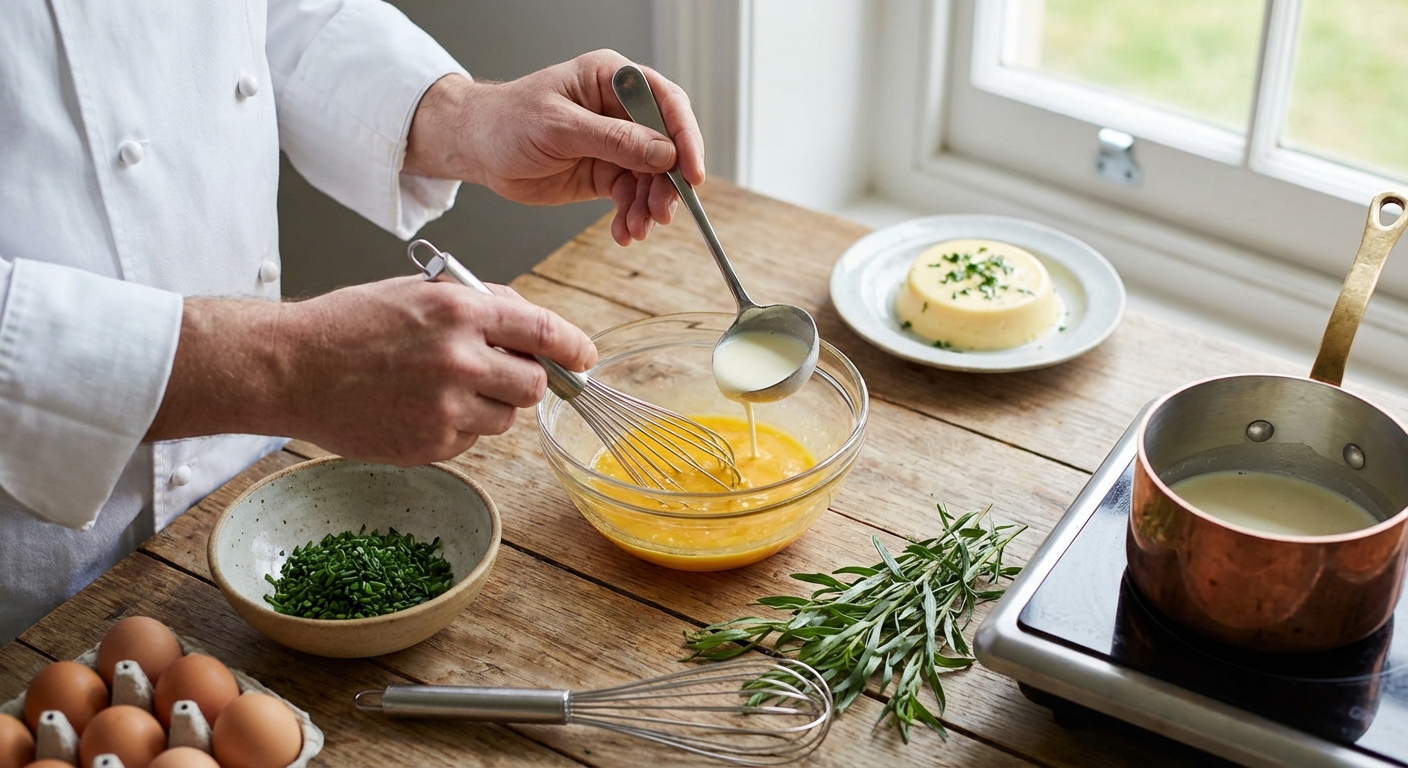
You are standing at the stove. The wooden spoon is in your hand. You are making the holiday eggnog or a classic crème anglaise. The recipe says to combine the hot milk with the eggs. You pour. You stir. Suddenly, the smooth texture is gone. Floating in your cream are little yellow rubbery bits. Scrambled eggs. The tragedy is real.
It happens to the best of us. The difference between a velvety custard and a sweet omelet is often a matter of seconds. It is also a matter of technique. You need to temper your eggs.
The Science of the Shock
Eggs are sensitive. They react violently to sudden heat. To understand why, you must understand protein coagulation.
In their raw state, egg proteins are curled up in tight little balls. When you add heat, these proteins unravel. They stretch out and bond with one another. This is coagulation. It turns a liquid egg into a solid.
Egg whites begin to coagulate around 140°F. Yolks follow shortly after, setting between 149°F and 158°F. Boiling water is 212°F. Simmering milk is often near 180°F or higher. Do the math.
If you dump 180°F milk directly onto cool eggs, the shock is immediate. The proteins seize up instantly. They clump together. They squeeze out the moisture. You get curds.
Tempering prevents this shock. You introduce the hot liquid to the eggs slowly. You raise the temperature of the eggs gradually. You also dilute the proteins with the liquid. This spacing out of proteins makes them harder to clump. They bond loosely, thickening the liquid instead of solidifying into chunks.
The Method
This technique is not difficult. It requires patience. It requires two hands.
1. Set the Stage
Get your workstation ready. You have your pot of simmering liquid (milk, cream, or broth) on the stove. You have your eggs whisked in a heat-proof bowl.
Pro Tip: Place a damp kitchen towel under the egg bowl. This acts as an anchor. It keeps the bowl from spinning while you whisk. You will need one hand for the ladle and one for the whisk.
2. The First Ladle
Turn the heat down on your pot. Take one ladle of the hot liquid. Hold it over the bowl of eggs.
Start whisking the eggs vigorously. Do not stop whisking. Pour the hot liquid into the eggs in a thin, slow stream. Dribble it in. If you pour too fast, the eggs cook. Keep the liquid moving.
3. Repeat and Warm
Add a second ladle. Keep whisking. Add a third.
Touch the outside of the bowl. It should feel warm to the touch. The goal is to bring the egg mixture up to a temperature closer to the liquid in the pot. You usually need to incorporate about one-third to one-half of the hot liquid into the eggs.
4. The Reunion
Now the eggs are tempered. They are warm and diluted. Pour the egg mixture back into the main pot with the remaining hot liquid.
Whisk constantly while you pour. Turn the heat back on low.
5. The Nappe
Cook gently. Stir constantly with a wooden spoon or silicone spatula. Scrape the bottom of the pan. You are looking for the "nappe" consistency. This means the liquid coats the back of the spoon. If you run your finger through it, the line stays clean. It does not run.
Do not let it boil. If it boils, the proteins will over-coagulate. You will be back to scrambled eggs.
Where to Use It
Mastering this skill unlocks a tier of cooking that feels professional.
Desserts
Custards, pastry creams, and ice cream bases all rely on this. A tempered egg yolk provides richness and body. For holiday eggnog, tempering ensures a thick, safe drink without raw egg risk and without cooked egg lumps.
Savory Sauces
Hollandaise requires a form of tempering, often over a double boiler. Carbonara is another variation. You toss hot pasta with eggs and cheese. The heat of the pasta cooks the eggs gently. If the pasta is too hot, you get breakfast noodles. If you temper the eggs with a little pasta water first, you get a creamy sauce.
Soups
Avgolemono is the famous Greek lemon chicken soup. It uses egg and lemon to thicken the broth. You whisk hot broth into the lemon-egg mixture before returning it to the pot. It creates a cloudy, silky suspension.
Troubleshooting the Curdle
Sometimes you lose focus. The phone rings. You pour too fast. You see tiny flecks of yellow in your sauce.
Do not panic. You might be able to save it.
The Strainer
If the lumps are small, pour the mixture through a fine-mesh sieve immediately. This catches the cooked bits. The remaining liquid might be slightly thinner, but it will be smooth.
The Blender
If the curdling is starting but not total, an immersion blender can help. Remove from heat immediately. Blitz it on high speed. The shear force can sometimes smooth out the protein bonds.
The Ice Bath
If the mixture is cooking too fast even off the heat, plunge the bottom of the pot into a bowl of ice water. Whisk furiously to drop the temperature.
If the mixture has separated into clear liquid and solid chunks, it is gone. Start over. Pay attention to the temperature next time. Pour slower. Whisk faster.
Cooking is chemistry. Tempering is just managing that chemistry with a little finesse. You have the tools. You know the science. Go make that custard.
Sources and Further Reading
https://www.seriouseats.com/tempering-eggs-why-when-and-how-to-do-it
https://nielsenmassey.com/everything-you-need-to-know-about-tempering-eggs/
https://eggyguru.com/2016/06/20/the-science-of-cooking-an-egg/
https://opentextbc.ca/modernpastryandplateddesserts/chapter/coagulation/
https://www.cadburydessertscorner.com/articles/how-to-fix-common-issues-when-making-custard
https://nielsenmassey.com/betteryourbake/how-to-temper-eggs/
https://fitttzee.com/knowledgebase/custard-problems-and-solutions
Ready to transform your kitchen?
Stop juggling screenshots, bookmarks, and cookbooks. Import recipes from anywhere and build your perfect digital recipe book with Foodofile.
Get Started for Free